
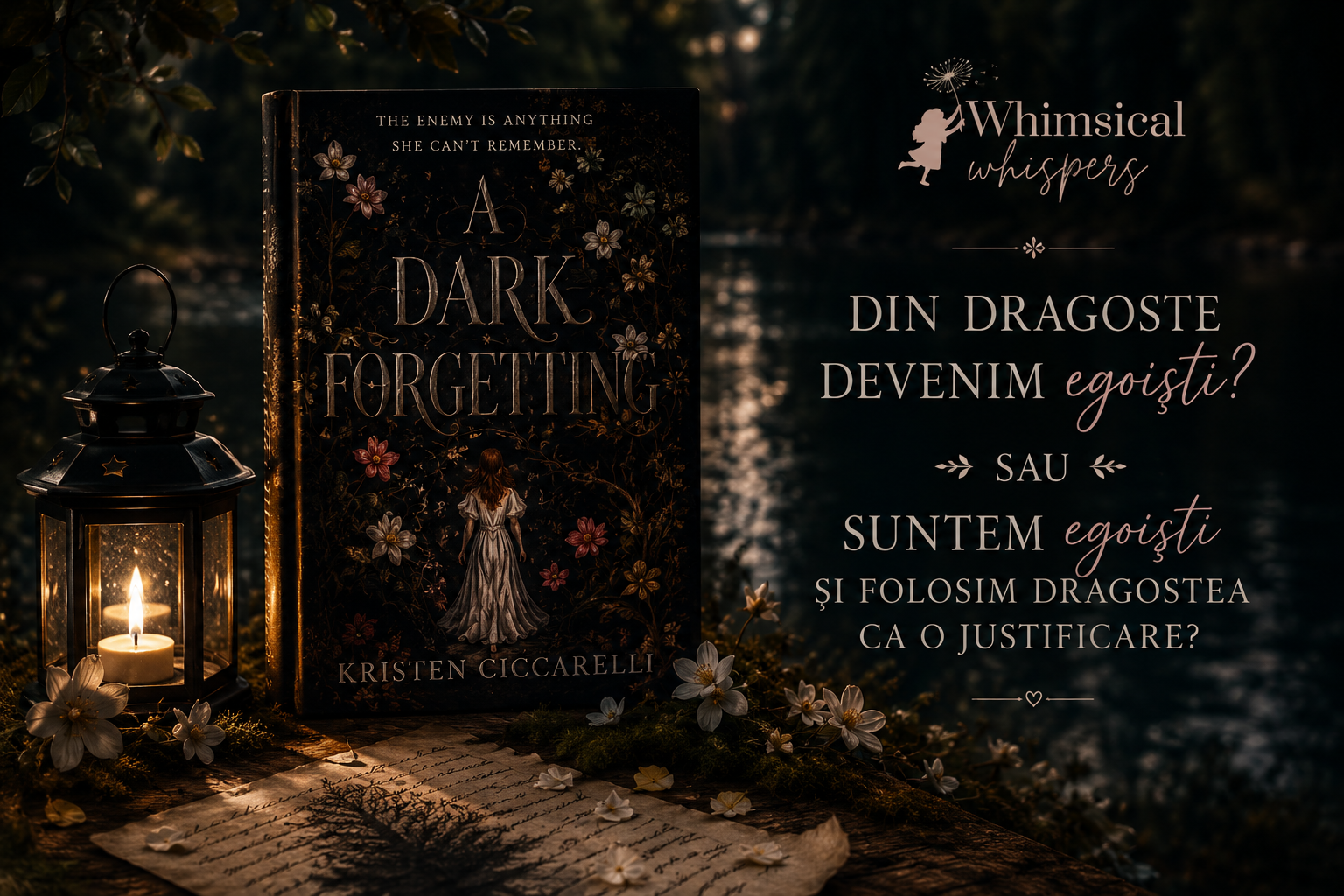
📖 Some books tell you a story. Others are leaving you with questions.
A few days ago, I finished reading A Dark Forgetting, and it is still alive in my head.
Not the monsters.
Nor the magic system.
Or the romance.
But the questions it left behind.
And maybe this is the greatest compliment I can pay to a book. The stories that I forget the minute I close the book don`t matter.
But those who stick with me for days? Those are the dangerous ones.
🌺 What if the writing chases you out of the story?
I have a confession to make. In the beginning, we did not get along at all. The writing felt forced and overly poetic, at times so focused on beauty that it lost clarity. Monsters were killed and transformed into flowers, while people sang as the entire woodland community graduated from the conservatory. The author is trying to introduce us to a poetic world, but sometimes all we get is more confusion than imagination.
When I read, the words create vivid images in my mind. However, when those images and words don’t align, the experience feels disjointed. Engaging stories should flow seamlessly, allowing us to fully immerse ourselves in the narrative.
The good news?
The writing evolves alongside the story, becoming more mature and calmer. It flows naturally, and by the end, the style and subject blend into a surprisingly harmonious result.
🧠 Alzheimer`s – useless detail or key to the entire story?
In the beginning, I was sure that Emeline’s grandfather was there only to move the story along. Boy, was I wrong. Looking back now, Alzheimer`s is the embodiment of the most cruel type of forgetting from the entire book.
The mother forgets who she is. The king forgets who he was. The forest forgets how to live. The entire magical world shrinks and decays, as if trying to disappear. Yet amid all this, there is a fundamental discrepancy. Everyone else has a chance; they possess magic, bear curses, have meanings, and hold on to hope. But PA has nothing. For him, forgetting is not a choice, not a sacrifice, and not a consequence. It simply claims his mind, his life, and his soul. In this way, forgetting becomes infinitely scarier than the monster lurking in the woods.
🌳 Hawthorne – the surprise I did not see coming
To tell you the truth, halfway through the book, I still was not convinced that Hawthorne is as important as the author is trying to make him be. And then bam! For the first time, I had the feeling that there was a twist well built and well deserved.
The idea that Hawthorne was a tree that wanted to become human just because he fell in love with the voice of a girl might seem ridiculous, but it works. This is not a story about magic; it is a story about yearning, love, sacrifice, and the price that we need to pay for the things we want the most
❤️ What is love: sacrifice or selfishness?
I think this is the true dilemma of the book. This is the question that still lingers in my mind.
Are we becoming selfish because of love? Or are we already selfish, and we use love to justify it?
It is very easy to say:
„I love you”
or
„You are my life”
„You are my heart.”
„You mean everything to me.”
But what is the worth of these words when a sacrifice is needed? When love asks for something in return? When you need to choose between your own dream and the person you love? Furthermore, do we have the right to choose for someone else in the name of love?
This book does not offer simple answers, and that is why I liked it.
✨ About faith and things that cannot be forgotten
The most beautiful idea in the entire book is that some things endure even as memories fade. You can take away someone’s past, erase memories, or destroy their story. But can you truly erase a person’s essence?
Emeline and Hawthorne meet again; they choose each other once more; they love each other anew, as if connections exist somewhere beyond memory, as faith always finds its way back.
📝 Verdict – ⭐️ 3.5/5
A Dark Forgetting is not a perfect book. It has moments when the metaphors overwhelm the explanations, and it has a suspiciously close relation with flowers and characters that sing so well that it makes me wonder if, by some miracle, there is a conservatory in the woods.
But it also has something that other books lack. It has ideas, questions, and themes that keep leaving long after the last page. And maybe this is the real reason that I am still thinking about it. Because, beyond magic, monsters, and curses, this book left me with a question that I have yet to find an answer to.
Are we becoming selfish because of love? Or are we already selfish, and we use love to justify it?
When we choose for the one we love, is it sacrifice or control? When we give up our own dreams for the benefit of someone else, is it love or losing a part of ourselves?
And, maybe the hardest question of all…
If you love someone so much that you sacrifice their freedom of choice for what you think benefits that person, is it still love?
