
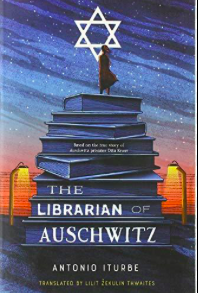
“The Librarian of Auschwitz” tells the story of the forbidden school from Auschwitz Birkenau. The writer Antonio G Iturbe takes his place on the list of writers inspired by the Jewish tragedy during the nazism.
The location is the concentration camp Auschwitz-Birkenau. The book is based on the confessions of Dita Polachova, married name Kraus, the live model for the character Edita Alderova. This story is not a journal of the discussions had by the author with Dita, but at the same time it is not a fiction novel. In fact, in front of us, it unravels a tapestry of fiction based on the terrible realities lived by Edita Alderova.
Although it looks promising, the book disappoints from the first page till the last one. It touches on a lot of subjects without any continuity, perspectives are shifting at a rapid pace with no connection with the story. It is like you hold a hand full of strings, which are supposed to bring to life this puppet called the story of ” The Librarian of Auschwitz”. All these strings are cut off and the puppet lays lifeless.
The story
It is Edita’s story, the brave girl who safely keeps the 8 printed books of the forbidden school from Auschwitz Birkenau. Or it is Edita’s story, the girl who lives all her teenage problems inside the concentration camp of Auschwitz Birkenau, fighting the hunger, the cold, and the misery. Or it is a story focused on the growing up of Edita. She idolizes her mother, loves her mother, accepts her mother, detests her mother, loves her mother again, and watches her mother die. She never understands or supports her mother, not totally.
It is the story of Fredy Hirsch, the idealistic athlete who manages to create a forbidden school inside the concentration camp Auschwitz Birkenau, to give children a shred of normalcy and hope. Or it is the story of Fredy Hirsch, the closet gay man having a relationship with a German soldier. Or it is the story of Fredy Hirsch, the Resistance’s leader from inside the camp. When the moment to start the revolution comes, he kills himself, or maybe he is killed.
It is the story of Pistek and Rudy Rosenberg. It is the story of all the young people who fall in love and suffer inside the camp. It is the story of escaping misery, breaking free, and surviving.
It is the story of everybody, and it is the story of nobody. All the stories are started and left unfinished. The entire book is dominated by the existence of Joseph Mengele, which is only constantly mentioned with no real impact on the story. And my “favorite” moment, of course, appears Anne Frank, who dies one day after her sister Margot, both of them being buried in the common grave from Bergen-Belsen
What I liked
Almost nothing. I have started the book three times to be able to finish reading it once. I liked the idea of live books, the stories were told from memory by some of the teachers from this improvised school in the camp. I liked that in those terrible times, books were used to escape. All the people from the school building had the privilege of living in imaginary worlds, far from cold, hunger, misery, and death. And all of that because of the eight paper books and the six live ones.
What I didn’t like
Almost everything. Ignoring the lack of coherence in the entire book, the rhythm is extremely slow. There is an acute need to mention the head lice and the bedbugs, the human misery, and the food given. In a novel about the forbidden school from Auschwitz Birkenau, about hope and escaping inside imaginary worlds, we find talk about human trafficking. There is nothing about the children, their feelings, their view of things.
Edita Alderova is a mixture of bravery and curiosity, all normal for a teen. There are moments when her attitude is dominated by a badly placed sarcasm that brings no benefits to the character or the story.
I did not like the use of well-known names like Joseph Mengele and Anne Frank, as a way to give more value to the story.
Personally, I do not recommend this book. Even if you are passionate about this genre, the book is not worth it. In my opinion, there should be some kind of limitation in approaching this subject. There should be some kind of conditions to be met, to write about this subject. We cannot throw together some ideas and some names in a Holocaust salad and call it a novel.
Buy the book here: THE LIBRARIAN OF AUSCHWITZ
